
B15 · Household & Kitchenware
Stainless Steel Sheets for Kitchenware: 304/201 Selection and a Four-Part Checklist
For our kitchenware, we have organized four stainless steel categories: the commonly used 304 / 201 / 316, thickness 0.3–5 mm.
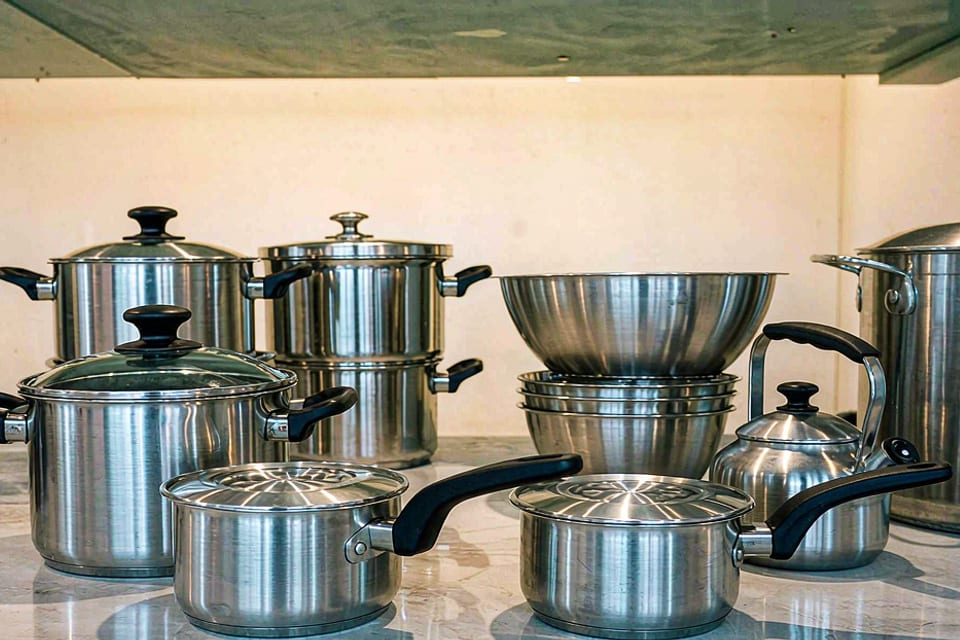
Four Parts and Material List
| Part / Component | Recommended Grade | Size / Thickness | Surface Finish | Configuration | Standards |
|---|---|---|---|---|---|
| Cookware/food/ceramic insulators | 304/316/201 | 0.3–1.2 mm | 2B/Electrolytic/Polished | Food contact + acid + cleaning + dry-heat discoloration | GB/T 3280; GB 4806.9 |
| Cutting tools/slicing blades | 420/440 | 1–5 mm | Hardened + Polished | Edge wear + Chipping + Food acid corrosion | GB/T 1220; GB 4806.9 |
| Sink/Laminated countertop/Splash guards | 304/201 | 0.8–3.0 mm | 2B/Brushed/Drawn | Moisture + Dishwashing liquid + Scratches + Food contact | GB/T 3280; GB 4806.9 |
| Material selection tips | 304/201 | 0.5–2.0 mm | Mirror/Polished/Gold-plated | Moisture + Soap solution + Scale + Hand skin | GB/T 3280 |
InsideStandard configurationCommon grades: 304 (3), 201 (3), 316 (1)
Material Types
- 304, 201, 316
- For acidic environments, start with 316L and move to 904L / duplex (2/4 times) as concentration and temperature increase.
- Thickness range 0.3–5 mm: thin sheets suit formed parts (consider bending springback and deep-drawing cracking), thick plates suit welded structures (consider heat transfer and sensitization).
FAQ
Which stainless steel grades are commonly used for household products and kitchenware?
Top 4 across all surfaces: 304 (3), 201 (3) and 316 (1). For specific parts, consider the environment and temperature — for example, stainless steel kitchen countertops exposed to salt water require 316L.
Which part is most likely to have issues?
Failure characteristics, typically for "pots/cups/thermos bottles": food contact + salt / acid + cleaning + dry-heat discoloration; recommended grades 304 / 316 / 201, thickness 0.3–1.2 mm. For this scenario, it is advisable to specify the medium concentration, temperature and cleaning method at the design stage.
What thickness should I choose?
The thickness range in the list is 0.3–5 mm. For thin sheets, consider bending and surface finish; for thick plates, consider welding and structural strength. Values may vary by equipment manufacturer for the same application — check your drawings or operating conditions.
Related Materials and Adjacent Industries
Supply cases for similar operating conditions
Kitchenware and cookware manufacturing
304 / 201 stainless steel circles, thickness 0.4–3.0 mm
Deep-drawn grade, Surface finish: 2B and BA, Diameter and weight made to order
Applications4
Thickness0.3–5mm